
The Families You Already Have: A Summer Retention Guide
Last week we wrote about the power of your graduates as an enrollment tool. This week, as more schools send their seniors off to their futures, 8th graders are getting ready for their high school journeys.
I’m assuming you have already counted those who walked across the stage compared to how many new freshmen will walk through the door in September. What is the difference in numbers telling you about your current enrollment?
Most districts spend significantly more energy and budget trying to attract new families than they do keeping the ones they already enrolled. And yet retaining a family costs a fraction of what it takes to replace one. How much budget is being spent on filling seats that were already filled 12 months ago?
Retention isn't glamorous. There's no campaign launch, no signing day, no visible moment of victory. It's quiet, patient relationship maintenance. This work usually doesn't get celebrated but absolutely gets measured on count day when you tally who came back and who didn't.
Summer is where that count is won or lost. And most districts don't realize it until August.
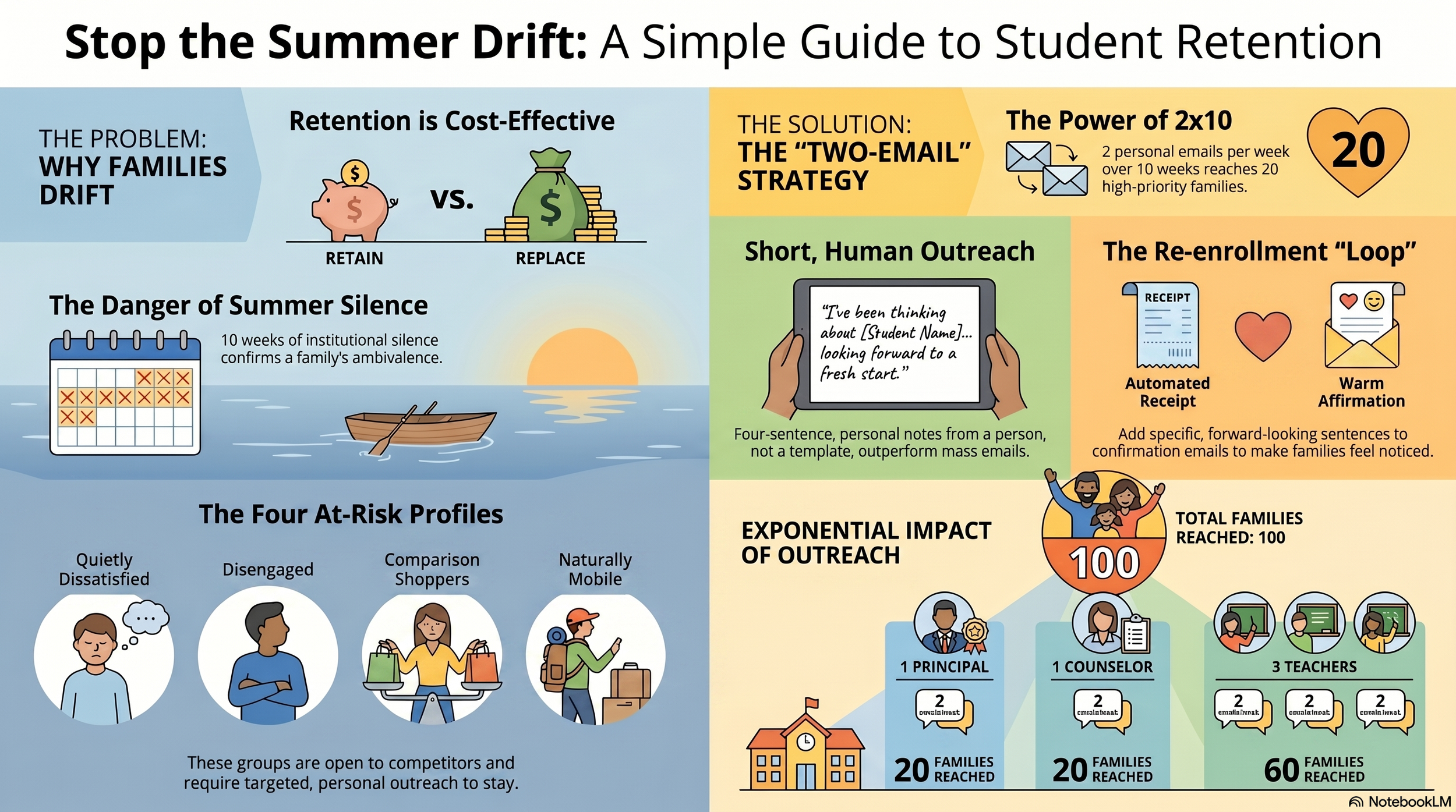
The summer drift problem
Families don't usually leave your district dramatically. They don't write angry letters or post frustrated rants or call the superintendent's office to announce their departure. They drift.
A family that felt slightly disconnected last year uses the summer to quietly research alternatives. A family navigating a job change or a move reconsiders everything, including their school choice. A family whose child had a hard year spends June and July wondering if somewhere else might handle things differently.
These families aren't gone yet. They're just open. And open families, in a school choice market, are exactly who your competitors are targeting while your district is quiet.
The summer retention problem is partly a communication problem. During the school year, families interact with your district constantly through drop-off, pickup, events, teacher emails, report cards, Friday folders, etc. Every one of those touchpoints is a micro-affirmation that your district is present, organized, and paying attention. Summer removes all of them at once. For a family already on the fence, ten weeks of institutional silence can feel like confirmation that their ambivalence is well-founded.
You can't replicate the school year's natural touchpoint density over the summer. But you don't have to. You just have to show up enough to keep the connection alive. Additionally, in a few specific cases, you have to show up personally.
Who is actually at risk
Not every family needs the same level of summer attention. Part of a smart retention strategy is knowing where to focus.
The quietly dissatisfied are your highest priority. These are families who had a frustrating experience last year and who haven't said anything since. They almost never tell you they're considering leaving. They just don't come back. By the time you notice, the decision is made.
The disengaged are families who never fully connected with your school community. They didn't join the PTO, didn't come to events, don't know the principal's name. They don't have a specific grievance. They just don't have a strong reason to stay. Belonging is a retention strategy, and these families never fully developed it.
The comparison shoppers are actively looking this summer. Private school families watching tuition bills. Charter families whose contract is up. Homeschool families who burned out but haven't committed to returning. These families will find something to compare you to. What they find when they look at your district over the summer matters.
The naturally mobile moved, changed jobs, or had a life event that reshapes their school decision. You can't retain everyone in this category. But you can make re-enrollment frictionless and your district's value clear enough that they choose you in their new situation. Or even better, refer you to a family moving in.
The communication sequence that holds families through summer
Mass communication has a role in summer retention. A genuinely warm end-of-year message before summer starts. A helpful resource email in June that makes your district feel useful rather than absent. A back-to-school excitement build in late July that gives families something to look forward to. These communications matter, and they're covered in the back-to-school planning framework from earlier in this series.
But the retention work that actually recovers the drifting family, re-engages the disconnected one, and keeps the quietly dissatisfied from making a phone call to another school doesn't come from a mass email. It comes from a person.
The two-email idea that could change your fall numbers
Here's a simple idea that most districts have never tried systematically, and that costs almost nothing to implement.
What if every principal wrote two personal emails per week over the summer? Not newsletters. Not mass communications. Two individual emails to specific families flagged as at-risk, families who had a hard year, families who are new to the district and haven't fully found their footing yet.
Ten weeks of summer. Two emails per week. That's twenty families per principal who receive a personal, direct communication from their building leader before August. In a building of 400 students, that's five percent of your families. Specifically, it’s the five percent who needed to hear from someone the most.
Now extend the model.
A counselor doing the same thing reaches twenty more families. Three teachers who know which kids had rough years or who stay in touch with families reach sixty more between them. In a single building, with minimal coordination and no budget, you've made personal contact with nearly a hundred families who might otherwise have drifted through summer without a single human touchpoint from your school.
Multiply that across every building in your district and the math becomes significant fast. This is the kind of exponential outreach that a communications coordinator alone can never achieve, but that becomes possible when the communications function is understood as a whole-district responsibility, not a one-person job.
What those emails actually say
The barrier to personal outreach is usually not willingness. The barrier is not knowing what to say, or feeling like anything short of a long, formal message isn't worth sending.
It is. In fact, shorter is better.
For a family whose child had a difficult year:
"Hi [parent name] — I've been thinking about [student name] and wanted to reach out before summer got too far along. I know last year had some challenges, and I want you to know those conversations stay with me. I'm looking forward to a fresh start in the fall and I'd love to connect before school begins if you have questions or just want to talk. Have a great summer."
That's it. Four sentences. No formal letterhead, no district communications template. Just a person, reaching out to another person, acknowledging that they exist and that they matter.
For a family that seemed disengaged or disconnected last year:
"Hi [parent name] — just wanted to send a quick note as we head into summer. [Student name] had a great moment in [class/activity] this year that I keep thinking about. We're excited for next year and I hope you have a wonderful summer. Don't hesitate to reach out if you need anything before August."
For a new family that joined mid-year or had a rocky transition:
"Hi [parent name] — I wanted to check in as we wrap up the year. Transitions are hard, and I know [student name]'s start with us wasn't without bumps. I think the world of where they ended up by June, and I'm genuinely excited about what next year looks like for them. Hope you have a restful summer."
None of these emails require research, approval, or a communications degree. They require knowing your families well enough to identify who needs to hear from you and caring enough to send the message.
Making it systematic without making it feel like a system
The goal is personal outreach that feels personal. That means the emails can't read like they came from a template, even if the idea behind them is systematic.
Here's how to make it work without it feeling manufactured:
At the end of the school year, before the last day, each principal and counselor identifies their list. Ten to fifteen families who had hard years, the ones who went quiet, the ones who raised concerns that didn't get fully resolved, the ones who feel like they might be on the fence. That list lives in a simple document, not a formal system.
Over the summer, two emails per week off that list. No tracking software required. A note in a calendar. A list on a notepad. Whatever the person will actually use.
The communications coordinator's role in this isn't to write the emails, but rather champion the system. To make the case to building leaders that twenty personal emails over summer is a retention investment that pays off on count day. To share what works. To collect the stories of families who responded warmly and use them to build buy-in for the following year.
You don't need everyone to participate for this to work. Three or four principals who commit fully will produce results visible enough to bring the rest along.
The re-enrollment moment
One more retention opportunity most districts handle badly: the re-enrollment confirmation.
When a family completes re-enrollment, they receive an automated confirmation email that reads like a receipt. Transaction complete. See you in August.
That's a missed moment. This family just made an active decision to come back to your district. They could have gone somewhere else. They chose you again.
Tell them you're glad.
A three-sentence addition to your re-enrollment confirmation:
Something warm
Something specific to the coming year
Something that makes the family feel like their return was noticed
This costs nothing and does real work. It closes the retention loop. It affirms the decision. It sends a family into summer feeling good about where their kid is going to school in the fall.
That feeling is what you're protecting all summer. Don't let the last communication they get from you before August be a form letter.
The close
Count day comes fast. And when it does, the retention work is over. The decisions have been made, the families who drifted have drifted, and the ones who stayed have stayed.
The window is now. It's a Tuesday in July when a principal sits down and writes two emails to families she's been thinking about. It's a counselor who picks up the phone for the family that had a hard year. It's a teacher who sends a three-line note to a kid who struggled and a parent who needed to know someone noticed.
None of it feels like a communications strategy. It feels like caring about people.
That's exactly what it is. It's also exactly what keeps them coming back.
