
Don't Go Quiet: Building a Summer Communications Plan That Sets Up Your Best School Year Yet
The last day of school is one of the loudest communication days of the year.
Final newsletters. End-of-year celebration posts. Field Day coverage. Graduation coverage. A superintendent's message about what a tremendous year it's been. Your social channels are full, your inbox is active, and every building in the district is buzzing.
Then the bell rings for the last time, and most districts go nearly silent for ten weeks.
No newsletters. Sporadic social posts, if any. A website that still has May's calendar on the homepage. An email list that won't hear from you until August, when suddenly everything is urgent again and families are expected to snap back to full attention as if nothing happened.
This is the summer lull, and it's not just a missed opportunity. When districts go quiet it's a strategic mistake dressed up as a well-earned break.
The argument here isn't that you need to post every day in July. It's that silence has a cost most districts never bother to calculate. The families who disengage over summer are harder to re-engage in August. The prospective families shopping schools in June and July find a website that hasn't been touched since May and a social feed that went quiet after graduation. The communicator who coasts through summer arrives in August overwhelmed, behind, and reactive from day one. That’s the worst possible way to start a school year.
There's another angle that doesn't get talked about enough. Summer is the best time to become something more than a school system. When you spend June and July being genuinely useful to your community by promoting the library's summer reading program, sharing the parks department's free camp schedule, or amplifying the food bank's back-to-school supply drive, you build a kind of goodwill that January’s enrollment campaign can't manufacture. You scratched the library's back all summer. They'll scratch yours when you need partner communications in the spring.
Summer is the off-season. All the best teams use the off-season to win.
Why summer communication matters more than most districts think
The temptation to go quiet makes a certain kind of sense. School is out. Families are busy. Open rates drop. It feels like nobody's listening, so why put in the effort?
Here's why.
Enrollment doesn't pause for summer. Families move in June and July. New residents arrive and start Googling schools before their furniture does. Private school families reconsider tuition in the quiet of summer. Homeschool families who've hit a wall start looking for alternatives. The families making school decisions right now are often the most motivated prospects your district will encounter all year. They’re actively searching, actively comparing, actively ready to be won over. And most districts greet them with a website frozen in May and a social feed that stopped posting after the fifth-grade graduation slideshow.
Trust is built in the margins. A helpful newsletter that lands in a family's inbox in July can do wonders for a family. It can tell them where their kids can get free lunch, what's happening at the library, or when sports conditioning starts. This does something that no amount of August urgency can replicate. It signals that your district is organized, that it cares, and that it communicates even when it doesn't have to. Families notice. They may not tell you they noticed. But when August comes and you're asking them to pay attention, trust you, show up, they remember whether you showed up for them in July.
The algorithm doesn't take summers off. Social media accounts that go dark for ten weeks don't pick up where they left off. Reach drops. Follower growth stalls. The platforms deprioritize accounts with inconsistent posting, which means when you need your audience most (like the upcoming back-to-school season) you're fighting an algorithm penalty you spent all summer earning. Consistent, lower-volume posting through the summer costs far less effort than rebuilding reach from scratch in August.
Your community doesn't stop having questions. Where can my kid get free lunch this summer? When does sports conditioning start? Is summer school still available? What forms do I need before August? If your district isn't publishing these answers, families find them somewhere else , usually a Facebook group that’s beyond your control. When you're the source, you control the accuracy. When you're not, you don't.
The three lanes of summer content
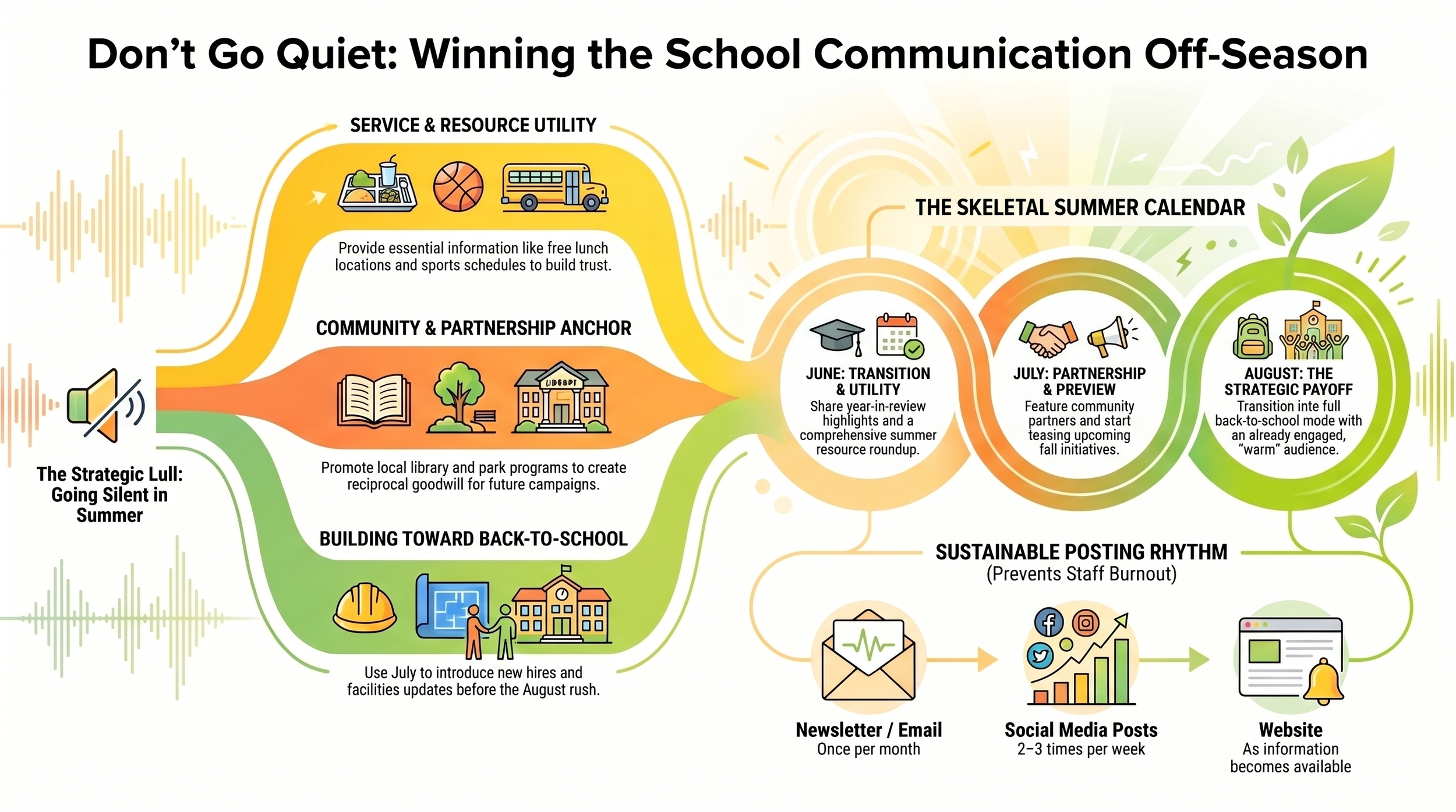
Not all summer content does the same job. The districts that handle this well think about summer communication in three distinct lanes, each with a different purpose and a different audience.
Lane 1: Service and resource communications
This is the content families actually need. It's not marketing. It's not brand building. It's utility that builds trust faster than any campaign you'll ever run.
In most districts, this content exists somewhere. The free lunch program has dates and locations. The mobile library has a route. The summer school has an enrollment deadline. The problem isn't that the information doesn't exist, it's that nobody publishes it where families can find it without making three phone calls.
Your job in this lane is to become the source. Free and reduced lunch program locations and times. Summer school enrollment and schedules. Reading challenges and library partnerships. Mobile library routes and stops. Sports conditioning schedules. School supply drives. Immunization clinic reminders before back-to-school health requirements kick in. Device return and pickup logistics for 1:1 districts.
A simple principle covers everything in this lane: if a family would Google it, you should be publishing it. Every unanswered question that ends up in a Facebook group is a service failure that also happens to be a content opportunity.
Lane 2: Community and partnership content
This is the lane where your district stops being a school system and starts being a community anchor. The distinction matters as it changes how families relate to you and how partner organizations see you.
Partner with local libraries on summer reading promotions. Cross-promote city and county parks department programming. Highlight local businesses offering back-to-school partnerships, discounts, or supply donations. Feature community organizations that serve your families: food banks, youth programs, workforce development resources. Collaborate with local museums, nature centers, and arts organizations on educational programming. Amplify community events your families would want to know about, even if your district had nothing to do with organizing them.
The framing that unlocks this lane is recognizing what you actually have: direct, trusted access to thousands of families. Local organizations want that access. Libraries want it. Nonprofits want it. Small businesses want it. You can offer genuine value to community partners without compromising your credibility. Just remember that you're always framing what you share as a community resource, not a commercial promotion.
A good rule of thumb: if the partnership serves a family first and the partner organization second, it belongs in your channels. If it's the other way around, it doesn't.
The other thing this lane does is build reciprocal relationships that matter later in the enrollment cycle. The library you promoted all summer will share your back-to-school materials with their patrons. The pediatric clinic that partnered with you on immunization reminders will mention your schools to new families. The parks department will feature your district in their fall programming guide. Community goodwill isn't soft. It converts.
Lane 3: Building toward back to school
This is the strategic lane. The content here does quiet, cumulative work so that August doesn't feel like starting from zero.
Start June with a look back. Think about a year-in-review post, a highlight reel of the year's best moments, a graphic with the numbers that matter. Families love this content. It also sets up a natural transition from celebration mode to forward-looking mode.
As summer progresses, introduce new staff hires as they're onboarded instead of saving all announcements for a single crowded August wave. Preview new programs and initiatives launching in the fall. Document facilities work like construction photos, renovation updates, before-and-after shots of building improvements. This content does something most districts underestimate: it builds community buy-in for capital spending before the school year begins. Families who watched the new gym get built all summer don't complain about the bond levy in September.
By late July, start teasing back-to-school information explicitly. Families who've been hearing from you all summer are already warm. A July 25th post that says "First day is three weeks away. Here's what to expect" lands differently than the same message sent cold to a list that hasn't heard from you since May.
The principle for this lane: back-to-school communications don't start in August. They start before school even ends. August is just when they get louder.
Building the summer content calendar
The practical question: what does this actually look like on a calendar?
Volume first. Summer doesn't need school-year intensity. A sustainable summer rhythm for most districts is one newsletter or email per month, two to three social posts per week, and website updates as information becomes available. That's enough to maintain presence, serve your community, and keep the algorithm satisfied without burning out a one-person shop.
Here's what a skeletal summer calendar looks like across three months:
June is about transition and utility. Year-in-review content. End-of-year celebration posts. A summer resource roundup — free lunch program, summer school, library programs, sports schedules — published before school ends for the year while families are still paying attention. Partnership outreach to community organizations you want to work with over the summer.
July is the partnership and preview month. Community partner content is running. Facilities update coverage. New staff introductions as hires are finalized. Mid-summer resource reminders for families who missed June's roundup. And by late July, the first back-to-school preview content: a tease of what's new, what's coming, what families should expect.
August is full back-to-school mode. The playbook described in the previous issue of this newsletter applies here — the checklist, the timeline, the communication sequences. August isn't where summer content ends; it's where the work you did in June and July pays off.
The best thing you can do with this calendar is build it in advance. Block two or three days in late May before the end of school chaos to draft and schedule as much summer content as you can. Write the June newsletter. Draft the social posts. Line up the partner content. Build the summer resource page on the website. Then schedule it all to go out while you do the quieter, slower work of the summer audit and back-to-school planning.
It's the closest thing to a real summer break a school communicator gets. You earn it by doing the work before everyone else has left the building.
One more thing: summer is the right time to pull in contributors. A principal who wants to write a welcome-back post. A teacher willing to share a summer reading recommendation. A student photographer documenting summer programming. The school year doesn't leave much room for that kind of collaboration. Summer does.
Use the quiet while you have it
The other gift summer gives you is time to think.
During the school year, you are always responding. A principal needs something by noon. A crisis needs a statement by five. The newsletter goes out Tuesday no matter what. There is no space to step back, evaluate, and improve. You're too busy executing.
Summer is the space. Use it.
Audit your website with fresh eyes. Read it the way a new family would in July, looking for the school year information they need. What's outdated? What's broken? What's missing entirely? Fix it before August, not after.
Pull your communication analytics from the past year. What emails got opened? What social posts performed? What content generated replies, shares, or direct messages? What got ignored? This data exists in your platforms. Most communicators never look at it. The ones who do make better decisions next year.
Talk to a handful of parents informally. What did they wish they'd known earlier last year? What communication did they find confusing or unhelpful? What do they actually read? The answers will surprise you, and they'll make your fall content sharper.
Clean your email list. Remove families who've left. Import new families from spring enrollment. Check for bounces. An email list that hasn't been maintained since last September is full of dead weight that skews your metrics and reduces your deliverability.
Refresh your brand assets. Update your photo library with the best images from the year that just ended. Rebuild your Canva templates with current logos and colors. Create graphics for every back-to-school communication you know is coming. August should never start with last year's look.
If you can do one more thing, write the first three newsletter issues of the new school year in draft form before Labor Day. They don't have to be finished. They just have to exist. You will thank yourself in September.
The close
The districts that communicate beautifully in September didn't get lucky. They built something in June and July that September gets to run on.
The off-season is where the work happens. The season is just where it shows.
You don't have to be loud this summer. But you can't afford to disappear.
